“Freight Train” is an American folk song written in the early 1900s by Elisabeth “Libba” Cotten (1893-1987) and popularized during the American folk revival of the 1950s and 1960s.

Cotten said that, as a teenager, she would sit outside her home in Carrboro, North Carolina, and watch trains roll by on the Norfolk Southern Line. Inspired by this sight, she penned a simple, albeit a bit morbid song—”Freight Train.” She marvels at the speed of the train and asks to be buried near the tracks when she dies so she “can hear old ‘Number Nine’ as it comes rolling by.”

For all you pickers and strummers out there, this is a tale to tell. A self-taught guitarist, Cotten developed her own original style. Being left-handed, she played a guitar strung for a right-handed player, but played it backwards and upside down.

This position required her to play the bass lines with her fingers and the melody with her thumb. Her signature alternating bass style has become known among folk guitarists as “Cotten Picking”—right- OR left-handed.
For a really good look at her “upside down and backwards” technique click or tap on the triangle in the next image and listen to her play another of her songs: “Washington Blues.“
Now, click or tap on the triangle in the next image to hear Cotten playing and singing her song “Freight Train“–in her nineties!
Elizabeth was the youngest of five children. At age seven, she began to play her older brother’s banjo. “From that day on,” she said, “nobody had no peace in that house.”

By the age of eight, she was playing songs. By her early teens she was writing her own including “Freight Train.” About that same time, she began working as a maid. By her late teens she was married and had given up her music for, as she said: “family and church.” She and her family eventually settled in Washington, DC.
Cotten “retired” from playing the guitar for 25 years, except for occasional church performances. She was then “discovered” by the musical family of Ruth and Charles Seeger while she was working for them as a housekeeper. She also cared for their children, including the young singers Mike and Peggy who grew up as mainstays of the folk music revival.

Charles (by the way, the father of Pete Seeger by a previous marriage) encouraged her. She remembered her guitar playing from her teenage years, picked up the instrument again, and relearned to play it. She did not begin performing publicly and recording until she was in her 60s.

In the latter half of the 1950s, Mike Seeger, both a musician and a musicologist, began making reel-to-reel recordings of Cotten’s songs in her home that later became the album “Folksongs and Instrumentals with Guitar,” released by Folkways Records.

Since the release of that album, her songs, especially her signature song, “Freight Train” have been covered by—it’s safe to say—nearly every folk singer in America.
Click or tap on the triangle in the next image to hear a young Joan Baez:
Click or tap on the triangle in the next image to hear their spin on this tune by Peter, Paul, and Mary:
With the profits from her recordings and concerts, she and her family moved to Syracuse, New York. In 1984, she won a Grammy for “Best Ethnic or Traditional Recording” for the album “Elizabeth Cotten Live.” She died at the age of 94.
.jpg?part=0.9&view=1&authuser=0)
So, we have a simple tune from humble beginnings, rediscovered and made available to we pickers and strummers today. A simple tune, a simple gift—not so simple backwards and upside down, however!
Finally, a final tune. Click or tap on the triangle in the next image for a look and listen.

So, play your guitar, ukulele, or banjo anyway you like–upside down or backwards. Not a piano, however!
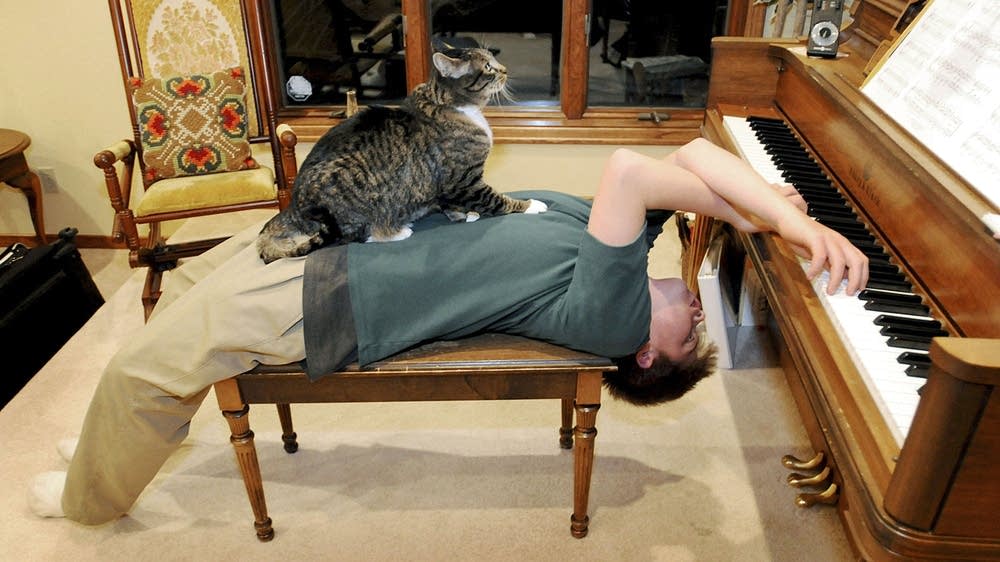
Well, I guess that’s OK too! Just play anything anyway, but STAY TUNED.

 NOHOBANJO OF NORTHAMPTON, AND NOW EASTHAMPTON, "MUSICAL MUSINGS"
Hi Bruce,
I love being introduced to Elizabeth Cotten. What an amazing musician and wonderful example for the children she visited.
Thanks for the fun research.
Diane
LikeLike
Very nicely told story of Elizabeth Cotten and her “Freight Train”! Thanks! And all the youtube players worked perfectly. What was the source of that lovely painting of her?
For a footnote, do you know the story of Nancy Whiskey’s record of the song? She was a Scottish folksinger who, taking her stage name from another folksong, was enlisted by a “skiffle” band in 1957 to sing “Freight Train” — Elizabeth Cotten’s melody and chorus, but new murderer-on-the-run story lyrics to what they said they thought was a copyright-free traditional song that had crossed the Atlantic with Peggy Seeger.
Along with Nancy’s vocal, they added whistling, and fast-freight rhythm on bass, washboard and three more chord-strumming guitars — and they sold a million records in the U.K.!
Elizabeth eventually got a royalties settlement — and recognition as the true composer in time for more recordings during the U.S. folksong “revival” in the sixties.
I’m not sure where the version by Peter, Paul & Mary fit in, with credit to “Mezzetti, Stookey, Okun, Travers” on the single’s label — the trio and their music director Milt Okun, Mezzetti being Peter Yarrow’s sister’s name, which he used for many of his writing credits from the group. Okun’s memoir may fill in some gaps, but I haven’t read it yet. (“Along the Cherry Lane: Tales from the Life of Music Industry Legend Milton Okun”)
https://secondhandsongs.com/work/119468
LikeLike