
During the so-called “roaring ‘20s,” jobs were plentiful for men and available for women who had to work for a living. Confidence and prosperity were in the air and the Great Depression of the ‘30s was years away. Still, a few songs reflected the simple things of life—just having a good time, just getting by, not going it alone. A couple of songs in our songbooks remind us of this musical point in history: “Side by Side,” and “Ain’t We Got Fun.”

A simple song that tells a simple story is the 1927 tune “Side by Side.” This was written by Harry Woods (1896-1970), a Massachusetts native and Tin Pan Alley songwriter of many musical hits of the day. Click or tap on the triangle in the next image for a look and listen to this tune as filmed during World War II.
A couple of other tunes Woods wrote that show up in our songbooks are “When the Red, Red Robin Comes Bob, Bob, Bobin’ Along,” and “I’m Looking Over a Four-Leaf Clover.”

He composed his songs on the piano despite the fact that a birth defect had left him with a deformed left hand. Amazing!
Needless to say, dozens of other performers recorded the song all the way into the 1990s. With simple lyrics and a simple beat, it was a favorite “shuffle dance” duet on the vaudeville stage.

Moving on, “Ain’t We Got Fun” is a jaunty foxtrot recorded a few years earlier with music by Richard Whiting (1891-1938) and lyrics by Raymond Egan (1890-1952) and Gus Kahn (1886-1941)—all stalwarts of the Tin Pan Alley music scene during the Jazz Age and beyond.

Click or tap on the triangle in the next image to look, listen, and sing along with this one!
As folks were finding their way through the social and economic maze of the Great Depression, there were always songs touching on the brighter side of things. Wishful thinking, I presume, but they kept spirits afloat if not high above water!
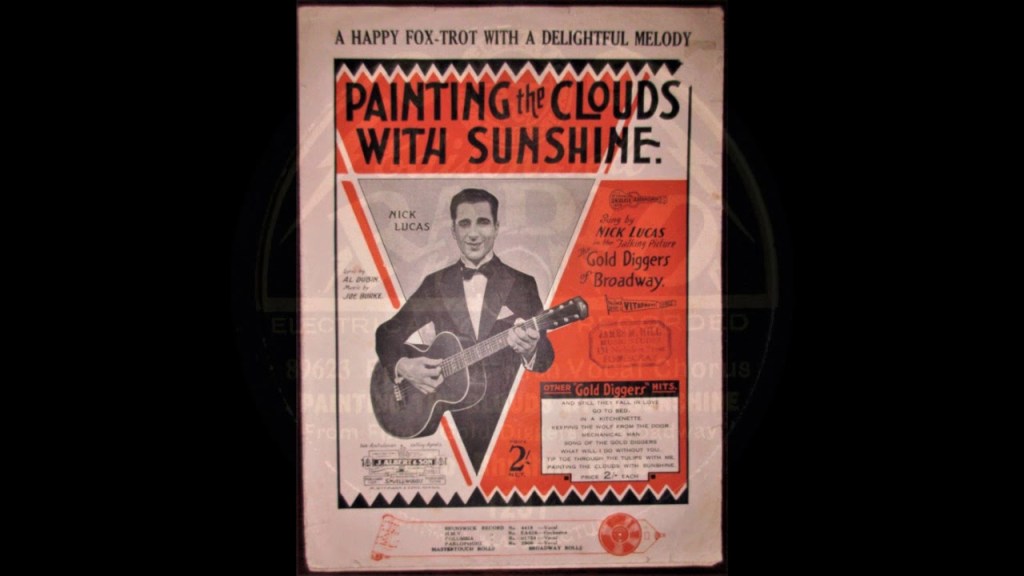
“Painting the Clouds with Sunshine” was published in 1929. It was composed by Joe Burke (1884-1950) with lyrics by Al Dubin (1891-1945) for the musical film “Gold Diggers of Broadway.” Another of their collaborations was “Tiptoe Through the Tulips With Me.” Just for fun, click or tap on the triangle in the next image for a look and listen.
Now, since I am a bit of a banjo fanatic, I can’t pass up a rendering of our song by another Massachusetts native, the great plectrum banjo player Eddie Peabody (1902-1970). I can’t vouch for his singing voice, but his banjo technique is both unique and superb! Click or tap on the triangle in the next image for a listen.
For those of you who might not be as banjo nuts as I, a plectrum banjo has 22 frets, four strings, and is played with a flat pick or “plectrum.”
Because of their universal themes, a variety of timely verses have been added and subtracted to these songs by performers over time. These songs, despite their jocularity, reveal a certain resignation to economic forces beyond the control of working people. They gave everyone a look on the brighter side.

“We’re In the Money” was written for the 1933 film “Gold Diggers of 1933” and is sung in the opening sequence by Ginger Rogers and the chorus. The music was written by Harry Warren (1893-1981) with lyrics by our friend Al Dubin. They collaborated on many, many songs including most of the musical “42nd Street.” Click or tap on the triangle in the next image for a look and listen to the film version of our song.
Oh why not? Click or tap on the triangle in the next image to see how this song was handled in the movie “42nd Street.”
So, here we have some simple songs that reflect the optimism—despite the uncertainties—of the so-called “sweet old days.” What will the songs and stories of today tell our grandchildren—uncertainties tempered with optimism; or, optimism tempered with uncertainties? Go figure.

And, as always, STAY TUNED!

 NOHOBANJO OF NORTHAMPTON, AND NOW EASTHAMPTON, "MUSICAL MUSINGS"