As many of you gentle readers are aware, I have been playing (alas, playing “at” rather than playing “well”) and collecting banjos and ukuleles since the 1950s. So, I thought it might be fun to muse a bit on my favorite type of ukulele marriage–the “banjo ukulele,” or as called by some, a “banjolele, or a just plain “banjo uke.” Please bear with me, gentle readers, but be prepared to be both entertained and enlightened. I hope!
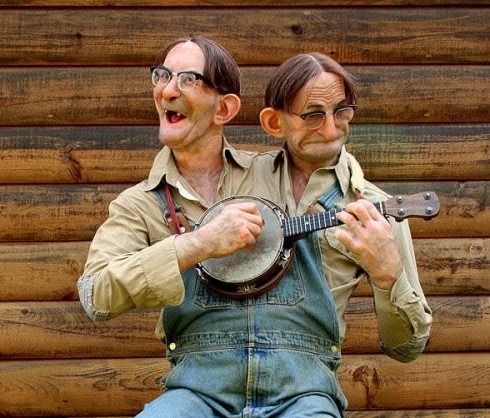
Friends and colleagues have mentioned that, in these trying times, they have found my meant-to-be-merry musings on musical lore diverting if not soothing. Well, maybe not that soothing this time around! You might want to turn those hearing aids down a notch or two as we begin with–what else?--an overture! Click or tap on the triangle in the next image to see what can be done with a banjo uke. Get your earplugs on if you must because HERE WE GO!
This week’s musing on banjo ukuleles is a bit longer and a tad more rambling than usual. It focuses on an instrument and style of playing that some folks might find a bit off-putting but is, nonetheless, a part of our musical heritage. Many of us strummers think it’s the only way to go; others remain, shall we say, unenlightened and, in fact, disdainful!
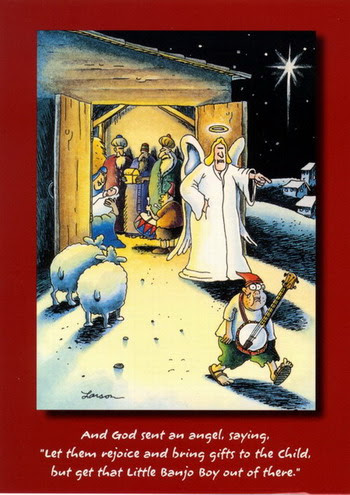
Most of you gentle readers and fellow strummers know that my go-to instrument for those Tin Pan Alley, old-time, and country tunes we enjoy has long been a banjo ukulele. I have a newer “Gold Tone Deluxe” tenor banjo uke, tuned gCEA just like a standard ukulele, and a vintage 1920’s “Bruno” baritone banjo uke, tuned DGBE like the top four strings of a guitar. These are set up with nylon strings and the sound can be softened with a rubber violin mute, but only when absolutely necessary!

To a lot of folks the bright, percussive tone of a banjo ukulele is thrilling, to others an acquired taste, and to still others . . . well. But this variation of the traditional uke goes way back in musical history. This might be nothing more than a “drum with a stick attached to it,” but this little instrument is taking off and has found more than a few fans over the past hundred or so years.

In 1916, San Francisco resident John A. Bolander patented the first banjo ukulele. In 1922, Hawaiiian-born Californian Alvin Keech, a ukulele player and vaudevillian, found himself in post World War I Paris performing on stage and in cafes. He and his brother, Kelvin, also made and sold several variations of banjo ukuleles that would become known as “Keech Banjuleles.” (Note the spelling.) Because of their musical and manufacturing efforts, the instrument became very popular in Europe, specifically France and Britain, and later in the US.
Here is one of their simple banjo ukes from the 1920s.

Most “Uke-ologists” credit Keech as the performing perfector and earliest promoter of the banjo uke if not the inventor. He perfected a fast-fingered strumming style that set the stage for banjo uke players of the day and set a goal for many today. Despite the fact that this is a “silent movie,” check out his fingering skills in both regular and slow motion. Click or tap on the triangle in the next image for a look if not a listen.
For some sound, here’s a look at a restored vintage Keech Banjulele in action today. Click or tap on the image to check it out.
Examples of banjo ukes from both sides of the Atlantic show, basically, a four-string standard soprano ukulele neck mounted on a six- to eight-inch cylindrical pot, or “drum,” with a skin head. In fact, banjos and banjo ukes soon became a lucrative sideline of big name drum manufacturers such as Slingerland and Ludwig.
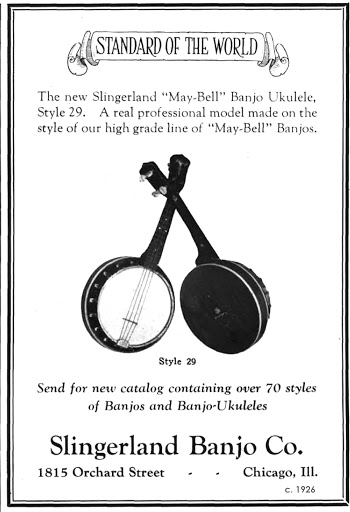
Before the advent of the banjo ukulele, however, short necked eight-string, four-course banjo mandolins or “banjolins” were available—usually with a ten-inch head. So were four-string versions called “melody banjos” and a five string version called a “piccolo” banjo.
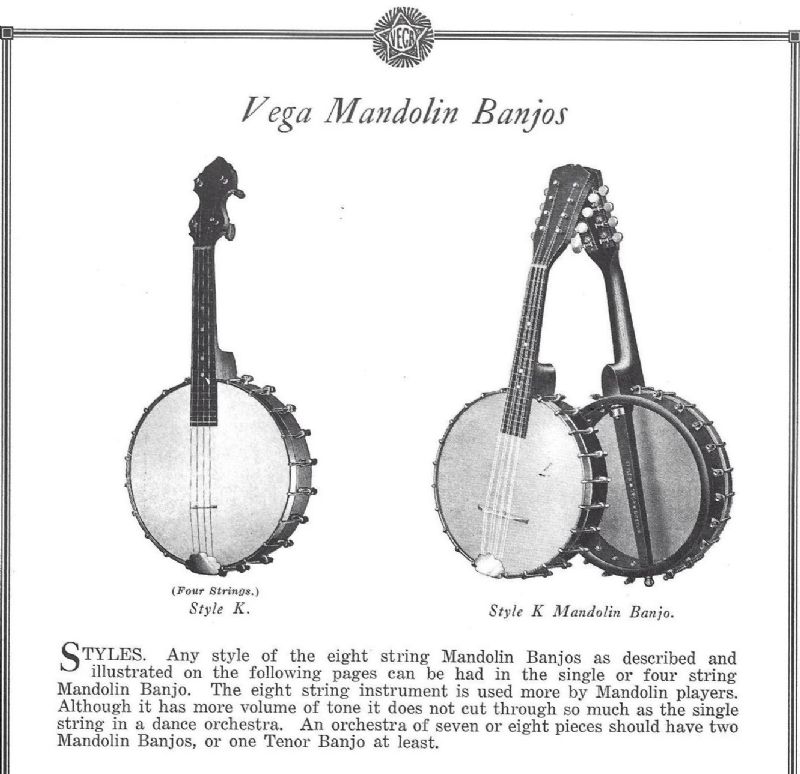
These were the “soprano voices” in the banjo bands or orchestras of the 1890s and early 1900s.

While banjo ukes are usually tuned in the standard gCEA, the melodies and banjolins were usually tuned in fifths like a mandolin or violin, GDAE.

The banjo uke became popular, particularly with vaudeville performers, because it was relatively simple to play, like a regular ukulele, and is, like a good “stage voice,” LOUD! Tap or click on the following image for an example performed in the “Keech style,” later and especially today called the “Formby style,” about which more later.
And, of course, there were many, many vaudeville or stage performers.


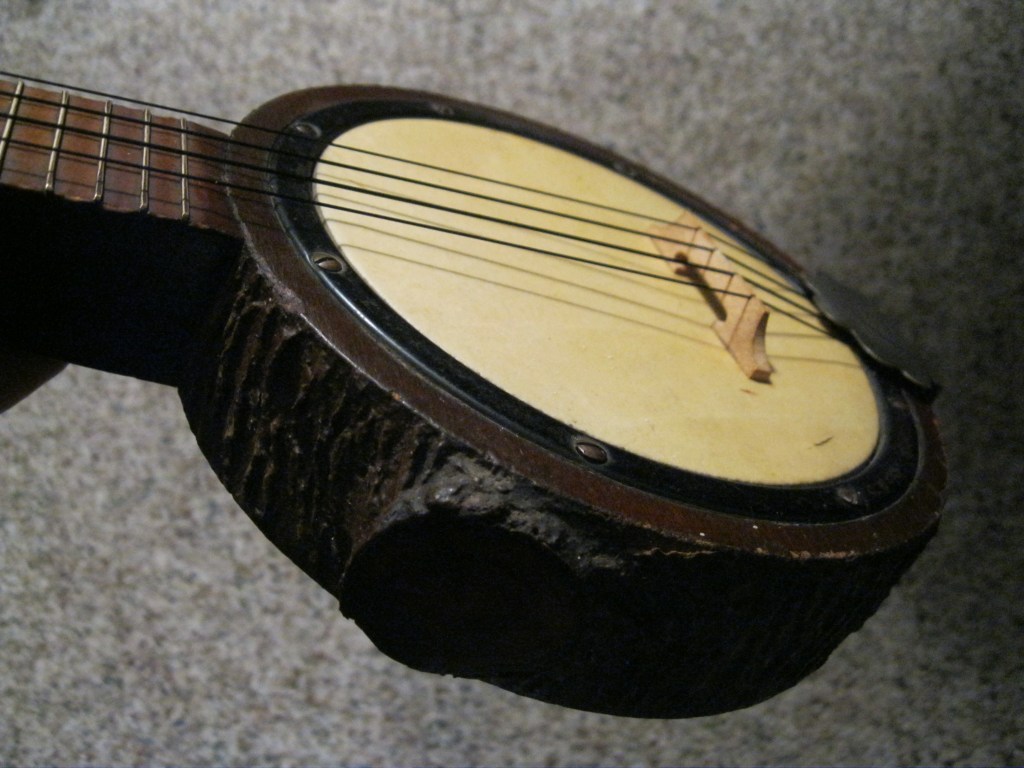
Some say that what drove the banjo uke into popularity, however, was that it was easier to build (read less expensive) than the more curvaceous, guitar-like standard ukulele. It was made up of a lot of interchangeable metal parts and the less expensive models required little fancy wood bending and finishing. You could even use a bit of an old log.
Or make big pieces out of little pieces.
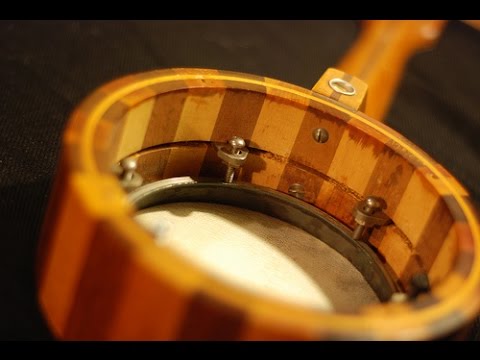
This, coupled with the popularity of Tin Pan Alley ragtime tunes, made the brighter, jazzier tone of the banjo uke THE sound of the 1920s and put a banjo uke into the hands of thousands. It seems that everyone wanted to learn, and many folks made money from songbooks as well as instruments!


As with all musical instruments, there are low-end as well as high-end models. Here are a few top-of-the-liners. A Stromberg Voisenette . . .
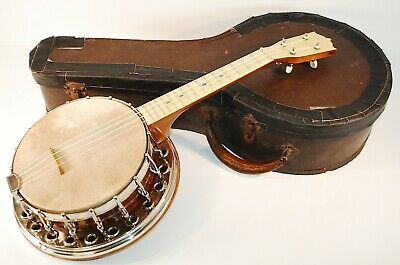
A Gibson UB-2 with resonator . . .

A gold-plated Ludwig Professional . . .

Simple styles cost only a few of dollars in their day while fully decked out vintage models–when found– easily can cost thousands or more in today’s market. Alas, none of those are in my collection!
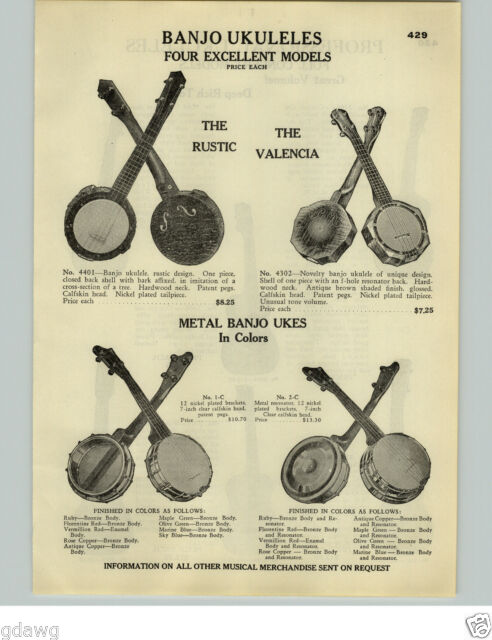
Anyway, banjo ukes are fun to look at, fun to play, fun to hear, and fun to collect.


And they are easy to decorate. A blank “canvas” so to speak!


They were popular with buskers and strummers in the sweet old days as well as now.


Now, I would be remiss if I didn’t include samples of two of the great banjo ukulele players of the past who epitomized the fast-fingered Keech/Formby styles, both British. First, there’s Tessie O’Shea who headlined alongside the Beatles when they did their famous first appearance on the Ed Sullivan TV Show.


Their joint appearance drew what was then the largest audience in the history of American television. Imagine that for a banjo uke player! Click or tap on the triangle in the next image for this YouTube if you have a few minutes!
And then, on to the King of the fast-finger players and the performer who gave his name to the style as played today, George Formby. Just imagine the generosity, wit, musicality, and personality of Bob Hope, Danny Kaye, Steve Martin, and Jerry Lewis wrapped up in one British music hall and film star.


His toothy grin became known to a worldwide audience through his many films of the 1930s and 1940s and his entertainment of the troops during World War II. On stage, screen, and records he sang light, comical songs and became the UK’s highest-paid entertainer. Some say that he made the banjo ukulele famous and he certainly made his fast style of play the goal of many players.
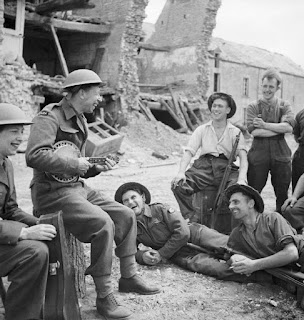
You might wish for sub-titles with this one, but this is one of his signature tunes. Click or tap on the triangle in the next image to watch and listen.
Playing in his fast-paced signature style is the goal of many of today’s banjo uke players and there are George Formby Society (GFS) clubs all over Britain. Needless to say, the banjo uke is HUGE in the UK!
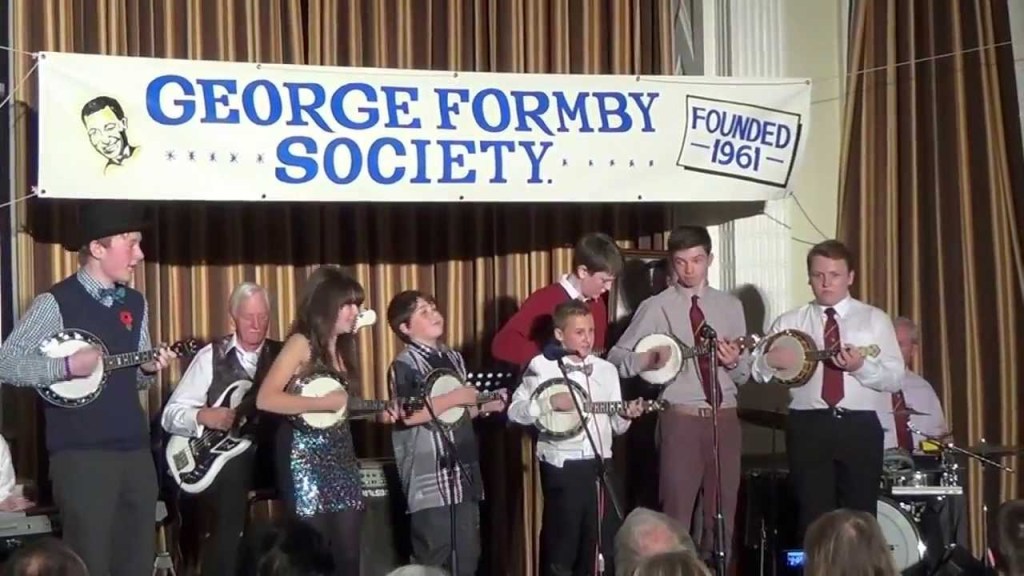
Now, to wind things up, here is the quintessential George Formby song as performed by the United Kingdom Ukulele Orchestra. Click or tap for a treat!
Alas, there isn’t anyone playing a banjo uke in this performance. Those folks are virtuoso ukulele players but it’s the Formby signature song that’s important.
But, of course, no one should be without a handy banjo uke! It can certainly play an essential role when necessary, so to speak.

Warning, gentle readers! Don’t try the above pose with this one!

Anyway, stay well, remain modestly dressed, turn those hearing aids back on, learn to love the banjo uke–and STAY TUNED!
Oh, why not! A pic of the old geezer himself!


 NOHOBANJO OF NORTHAMPTON, AND NOW EASTHAMPTON, "MUSICAL MUSINGS"
Hi There,
Nice article – but you have used two photographs from my website without asking permission to do so, and I have copyright on all images and text (past and present) shown on my site. The Big Gibson (which is actually a Gibson UB-3) and the gold plated and engraved Ludwig banjo uke photos were taken by me and used on my website. However, you can continue to use these photos on condition that you put ‘Photograph courtesy of theukuleleman.com’ next to each photo. If you’re not prepared to do this then please delete them from your article.
John Croft.
LikeLike
Hi John,
Sorry to have stepped on your photographic toes. Most of the photos I use in my musings are simply pulled from Google search images. I seldom go deeper into websites or other sources. Alas, this shortcut of mine seldom indicates if material is copyrighted. I’ll be more thoughtful in the future.
My so-called musings are written primarily to keep my 81 year old mind facile while my strumming fingers slow down. Most of my followers are members of our local ukulele club who appreciate learning more about their music and instruments. Needless to say they appreciate and learn from sources such as yours. And, needless to say, I will give credit where it is due if I use any of your lovely photos in the future.
STAY TUNED!
LikeLike