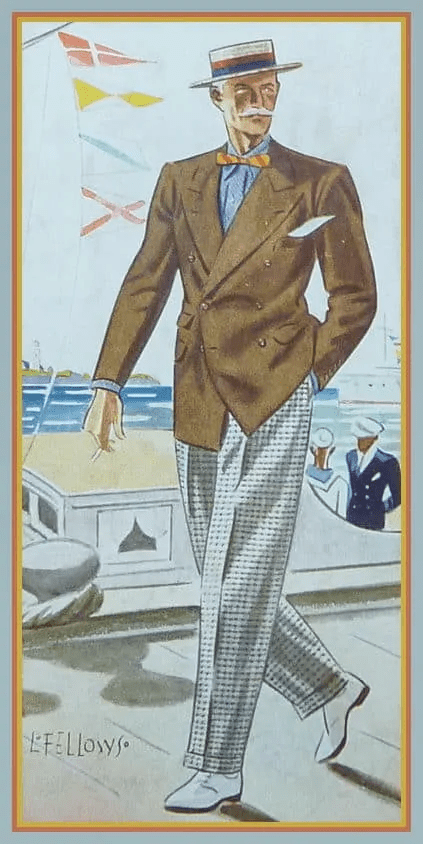
Well, here we go again. June is almost upon us, as is warmer (hot!) weather. It’s time think about wardrobe transitions. As a child, I remember my mother saying that her mother taught her that, after Memorial Day (Decoration Day to them), one may now wear white shoes and straw hats! I, of course, listened to my mother and–to this day–refrain from breaking the white/straw rule. Don’t you?
It’s also time for we Summer stylish gents (and ladies, of course!) to bring those Hawaiian shirts out of their winter storage bags and into our summer closets. Tis the season!
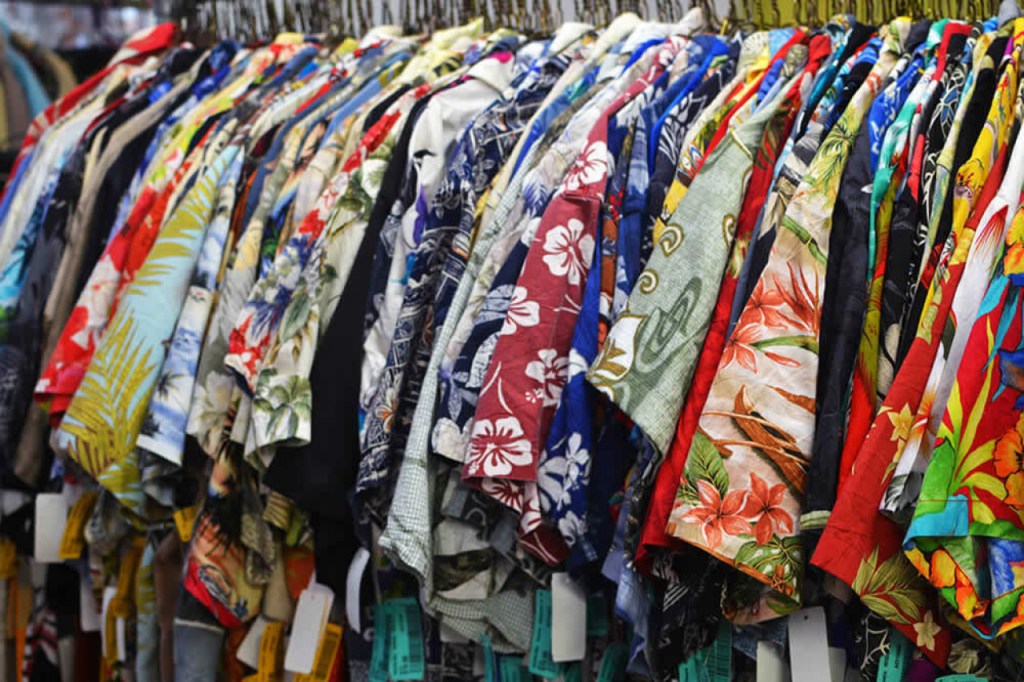
That being the case, I can’t pass up the chance to muse a bit on the history of this sartorial trend and to point to the protocols that “must” (well, “may”) be followed. And, there will be a tune or two. After all, gentle readers, this is a musical musing! And, ukuleles, salt water, warm weather, and Hawaiian shirts go together like “C,” “F,” “G7,” and back to “C.”
Click or tap on the triangle in the next image for a real Aloha!
As with my previous postings, of course, all is not mere frivolity. So, I’ll start with some serious scholarship about these shirts, their history, and place in our popular culture.

To go back a couple of hundred years or so, the first shirts associated with the islands were not what we think of today as a “Hawaiian Shirt.” Rather, these were simple, loose, long-sleeved work shirts, modeled after those worn by visiting British and American sailors.

They soon became the “uniform” for pineapple and cane field workers and island cowboys.


These came to be known as “palaka” shirts, from the Hawaiian word for “smock.” For the island trade, British cotton mills wove this denim-like fabric in a unique checked pattern which soon became known as “palaka plaid.”

Still made and sold today, this has become an iconic garment embraced by many native Hawaiians.

Click or tap on the triangle in the next image for a bit of musical palaka lore.
Moving on . . . In the 1920s a Japanese tailor in Honolulu came up with the novel idea of making shirts from odd remnants of printed silk he had on hand after making traditional kimonos.

These patterned, brightly colored shirts achieved almost instant popularity and soon became the standard for the local beach and surf crowd. And, of course, these became a must-have for the growing number of Mainland tourists.

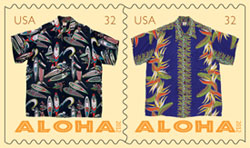
Then, in the 1930s, a Chinese tailor in Honolulu made and marketed a variation on these originals and had the entrepreneurial wit to copyright the name “Aloha Shirt.” The go-to garment that we know and love today was born!


Soldiers and Sailors stationed in Hawaii during World War II brought their colorful and casual silk and rayon shirts back home, as did more and more tourists in the ‘50s and ‘60s.

What was a cheap souvenir in those days has spawned an industry and early, well designed shirts have become scarce collectors’ items today.


Some sell for hundreds of dollars and even find themselves in museums and galleries.


Today, the Aloha Shirt (now a generic name) has become standard business attire for many in the islands—replacing neckties and jackets for some— during nearly nine months of the year.

As would be expected, the Aloha style even extends to those formal occasions where a tux would be called for in other climes.

For the women and girls, the cover-up of the “muumuu” (forced on bare-breasted native girls by those shocked nineteenth century missionary wives) moved from palaka plaid, to intricate patterns,

to the bright florals we see today in lovely dresses.

Click or tap on the triangle in the next image to hear the music and voice of one of the most popular muumuu wearing, singing “aunties” of Hawaii.
Click or tap on the triangle in the next image for a bit of muumuusical fun!
While Hawaiian flora and activities dominate fabric patterns, just about any theme can be found on a Hawaiian shirt these days. Ukuleles, of course!

Adult beverages, naturally!

Other interests or proclivities, you name them!

Presidents have worn them.

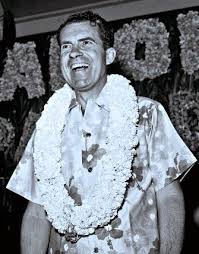

And even some police station mug shots show them!

And, movie stars and movies made them famous.


Click or tap on the triangle in the next image for a look and listen to an island icon!
And now, the BIG question! Do you wear a Hawaiian shirt tucked in, or not tucked in? The answer is simple—as with all shirts with a straight hem and side slits, you wear them UN-TUCKED and flying in the breeze.

Except, maybe, with a blazer in the office.

Or on a fashion show runway,

But is it acceptable to wear a shirt unbuttoned? It all depends. . .

And, they even work for really BIG guys like me!

So, let’s dig out and don our Hawaiian shirts for another summer. Why not?
Speaking of shirt music, how about a rap version of an “Aloha Shirt Song?” Click or tap on the triangle in the next image and look and listen for as long as you can stand it! It’s not my favorite musical genre, but I understand that there are folks out there who like this kind of stuff. Just sayin . . .
So, back to our sartorial exploration . . .
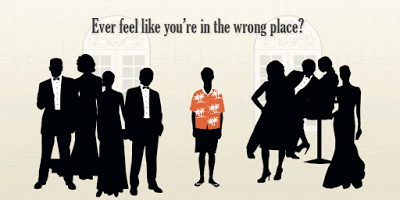
Not if you observe the Hawaiian shirt rules, send us postcards from the islands, . . . and STAY TUNED!

 NOHOBANJO OF NORTHAMPTON, AND NOW EASTHAMPTON, "MUSICAL MUSINGS"